

According to the latest data from the Vietnam Association of Seafood Exporters and Producers (VASEP), Vietnam seafood export began 2025 with a slight growth of 3%, reaching USD 774 million in January, despite the Lunar New Year holiday. The U.S. imposition of a 10% tariff on all imported goods from China may lead U.S. businesses to seek alternative suppliers from Vietnam, particularly for fresh/frozen fillets and pangasius fish.
However, exports to the U.S. also face challenges such as rising transportation and logistics costs due to increased demand for exports to this market. This article will provide an in-depth analysis of non-tariff barriers, challenges faced by Vietnamese seafood exporters, and strategic solutions to help businesses seize opportunities, overcome challenges, and sustain long-term growth.
For support in meeting U.S. food safety standards (FDA, USDA) and joining C-TPAT Program to navigate non-tariff barriers, please contact UNI now to get expert consultation.
1. Understanding Non-Tariff Barriers (NTBs) in Seafood Exports
1.1 What are non-tariff barriers?
Non-Tariff Barriers (NTBs) refer to trade restrictions that are not tariff-based but have economic impacts on the flow of goods between countries. Globally, NTBs are increasingly replacing tariffs as significant obstacles to trade, especially for exports from developing countries to developed markets.
In seafood exports, NTBs commonly include regulations on quarantine, food safety, traceability, import quotas, certification requirements, and technical standards.
1.2 Why do they matter for seafood exports?
a. Meeting food safety standards
Firstly, NTBs ensure that exported seafood meets strict food safety and hygiene standards. For example, the U.S. and EU prohibit seafood imports containing antibiotic residues exceeding permitted levels, requiring Vietnamese exporters to enhance product quality. This helps improve the reputation of Vietnamese seafood in the international market.
Many countries enforce sustainable fishing regulations, such as Marine Stewardship Council (MSC) certification and Illegal, Unreported, and Unregulated (IUU) Fishing regulations. These barriers encourage businesses to comply with legal and sustainable fishing standards, contributing to the long-term protection of marine resources.
b. Build brand credibility and enhance product value
In addition, While NTBs pose challenges, meeting these standards helps seafood exporters build brand credibility and increase product value. Certified seafood products, such as those with Aquaculture Stewardship Council (ASC) or Best Aquaculture Practices (BAP) certification, can be sold at premium prices and attract high-end U.S., EU, and Japan consumers.
c. Avoid export suspension or import bans.
However, failure to comply with NTBs can lead to export suspension or import bans. For example, the EU issued an “IUU yellow card” warning on Vietnamese seafood, subjecting many shipments to stricter inspections, slowing down exports, and increasing costs.
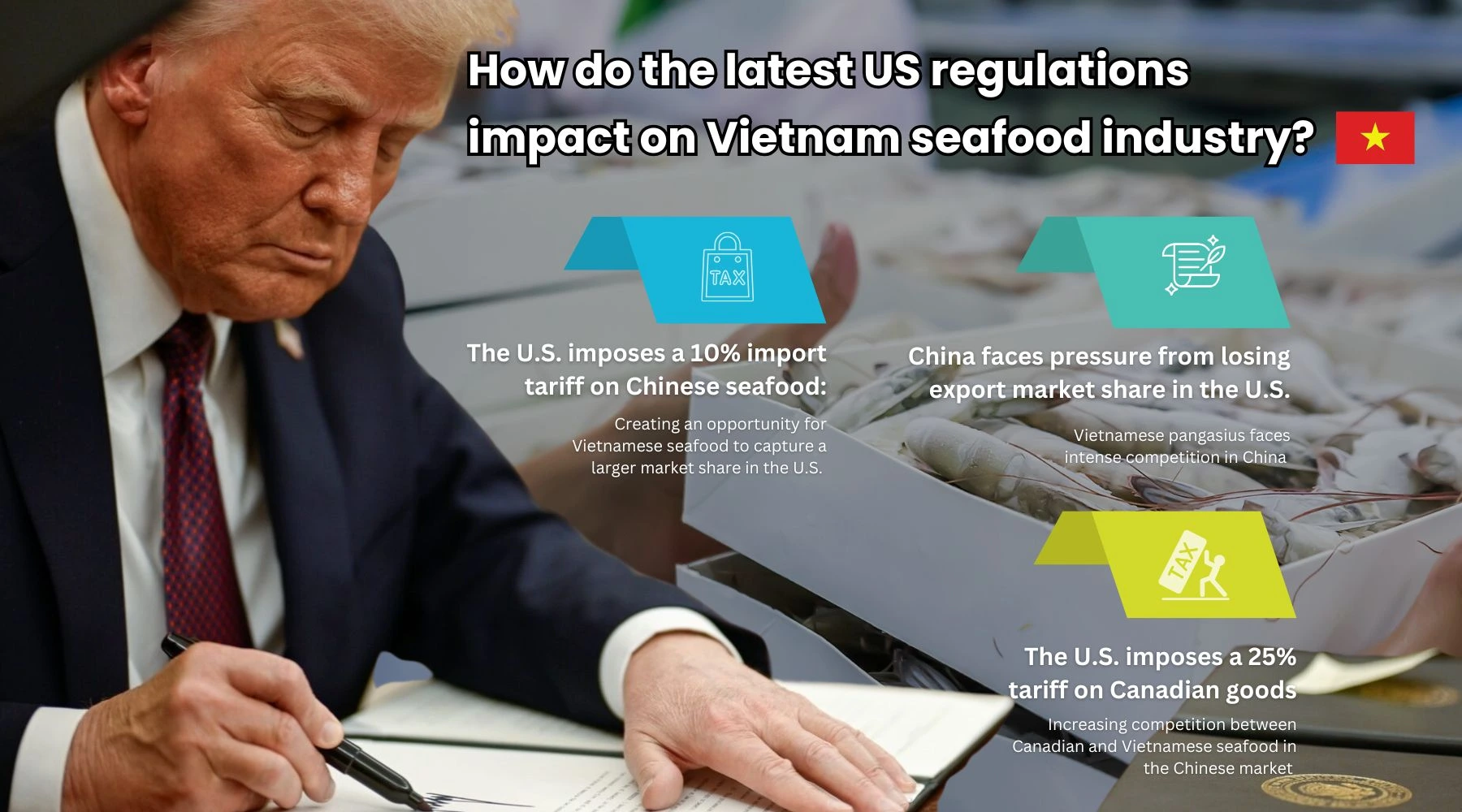
2. How do the latest US regulations impact on Vietnam seafood industry?
U.S. tariff policy changes present opportunities and challenges for Vietnam’s seafood industry.
a. The U.S. imposes a 10% import tariff on Chinese seafood: Creating an opportunity for Vietnamese seafood to capture a larger market share in the U.S.
The U.S. imposition of a 10% import tariff on Chinese seafood has driven up the cost of Chinese products, creating an opportunity for U.S. businesses to seek alternative suppliers from Vietnam. Vietnamese pangasius, with its price advantage over Chinese tilapia, is likely to capture a larger market share in the U.S. If pangasius accounted for 40% of the U.S. market in 2024, this figure could rise to 60% by 2025.
Furthermore, other seafood products such as shrimp, tuna, and squid may see expanded export opportunities as the U.S. reduces imports from China. Processing businesses in Japan and Canada may also shift operations to Vietnam to re-export to the U.S.
b. China faces pressure from losing export market share in the U.S.: Vietnamese pangasius faces intense competition in China
However, the U.S. tariff policy could intensify competition in China’s domestic market. Facing export losses to the U.S., China may increase domestic seafood consumption and expand exports to other markets. Vietnamese pangasius could face stiff competition from Chinese tilapia in China itself. Furthermore, the U.S. tightening import standards poses another challenge for Vietnamese exporters in meeting quality, traceability, and food safety requirements.
Potential Chinese retaliatory trade measures against the U.S. could also impact Vietnam indirectly. If China reduces imports of salmon, cod, and crab from the U.S., these products might flood other markets, increasing competition. Nevertheless, Vietnam could benefit from rising demand for fresh/live seafood in China’s high-end segment.
c. The U.S. imposes a 25% tariff on Canadian goods: Increasing competition between Canadian and Vietnamese seafood in the Chinese market
Additionally, the 25% U.S. tariff on Canadian goods could significantly impact trade. If Canada struggles to export to the U.S., it may increase seafood trade with Vietnam to find alternative markets. Canada supplies cod, snow crab, and lobster to Vietnam for processing and re-export. This could help Vietnamese businesses expand processing operations and leverage Canadian raw materials.
However, Canada losing its U.S. market share might also push it to focus on China, competing directly with Vietnamese seafood. Canadian shrimp, crab, and fish entering China at competitive prices could reduce demand for Vietnamese seafood in that market.
Source: Vu Quang (2025), Seafood exports in the context of new tariffs: More opportunities than challenges
Read more>> Impact of Trump’s 25% tariffs on Vietnam’s steel and aluminum: Impact on Vietnam >>
3. Common Challenges Faced by Vietnam Seafood Exporters
List all challenges of Vietnam seafood exporters
Below are the common challenges faced by Vietnamese seafood enterprises in the process of exporting seafood to international markets.
3.1 Rising export costs and the risk of anti-dumping and countervailing duties
The U.S. tariff policy in 2025 could significantly increase export costs for Vietnamese seafood businesses. Additionally, the risk of being subjected to anti-dumping and countervailing duties poses challenges in maintaining a competitive edge in the U.S. market.
3.2 Impact of climate change on raw material supply
Climate change is altering the natural habitats of seafood, particularly in aquaculture. Rising sea levels, temperature fluctuations, and water pollution could lead to disease outbreaks, reducing both the quality and availability of seafood raw materials, and ultimately disrupting the export supply chain.
3.3 Intensifying competition from major exporting countries
Leading seafood-producing nations such as India, Thailand, China, and Ecuador are increasing their output and improving product quality. This intensifies price, quality, and export standard competition, diminishing Vietnam’s advantage in the global market.
3.4 Rising input costs and transportation expenses
The increasing costs of animal feed, fuel, transportation, and logistics are driving up seafood production expenses. Higher input costs lead to increased product prices, making Vietnamese seafood less competitive against global rivals.
3.5 Impact of trade wars and market barriers
Trade conflicts between major economies, especially the U.S. and China, could disrupt global supply chains, affecting raw material prices and transportation costs. Vietnamese exporters must navigate price fluctuations and stricter origin requirements, creating hurdles in the export process.
3.6 Risks from the IUU yellow card and trade protection measures
The IUU Yellow Card, C-TPAT (Customs-Trade Partnership Against Terrorism) standards, and trade protection measures such as anti-dumping and countervailing duties could increase compliance costs, reduce raw material availability, and weaken the competitiveness of Vietnamese seafood exporters.
3.7 Effects of geopolitical upheavals on seafood trade
Political tensions and regional conflicts can heavily impact Vietnam seafood exports. Shifts in trade policies, economic sanctions, or diplomatic disputes may disrupt supply chains and negatively affect Vietnam’s main export markets.
Source: VASEP (2025), Vietnam’s Seafood Exports in 2025: Opportunities and Challenges
4. How UNI Helps Businesses Overcome These Barriers
To help Vietnam seafood export businesses overcome non-tariff barriers in an increasingly competitive export market, UNI offers in-depth solutions to ensure smooth business operations.
4.1 Customs Clearance Support
a. Participation in the C-TPAT program:
With UNI’s customs clearance support, seafood export businesses can participate in the C-TPAT (Customs-Trade Partnership Against Terrorism) program to ensure supply chain security and faster clearance in international markets, especially the United States.
b. Food quarantine consulting:
We will help businesses comply with U.S. food safety and quarantine regulations such as the FDA (Food and Drug Administration) and USDA (U.S. Department of Agriculture). By ensuring these quarantine regulations, businesses can increase market access and reduce the risk of goods being returned.
4.2 Anti-dumping duty exemption consulting:
In addition, with rich experience in assessing and registering anti-dumping duty exemptions, UNI can help Vietnam seafood export companies minimize unnecessary taxes and enhance competitiveness in the international market.
With extensive experience and a team of experienced experts, UNI is committed to accompanying businesses to overcome non-tariff barriers and expand global business opportunities. Contact UNI now for advice from customs experts.
5. What should Vietnam seafood export enterprises do?
Although it is not yet possible to predict whether Vietnamese seafood will be subject to new tariffs and when they will be applied because they still depend on many conditions, experts from the Vietnam Association of Seafood Exporters and Processors (VASEP) believe that the opportunities seem to outweigh the challenges.
“The seafood industry can seize opportunities and achieve breakthroughs if the supply of raw materials is stable in both quantity and quality. Given the constantly evolving international trade landscape, businesses must develop contingency plans to avoid supply chain disruptions. It is essential to establish sustainable and flexible supply channels, including both domestic raw materials and imported sources when necessary, to prevent shortages,” advised Ms. Lê Hằng, VASEP’s Communications Director.
Additionally, businesses should stay informed about market trends and adjust product-market strategies accordingly. For example, it is possible to increase the market share of pangasius in the U.S., promote the export of fresh seafood to China, balance to have competitive products in ASEAN, expand market share in the Middle East market, etc.
In particular, it is necessary to invest more in deep processing to increase added value and expand market share in markets, and at the same time avoid anti-dumping duties and other tax barriers in this new context, Ms. Le Hang emphasized.
Source: Vu Quang (2025), Seafood exports in the context of new tariffs: More opportunities than challenges

Conclusion
Pressure from new U.S. tax policies is causing Vietnam seafood export businesses to face increasing costs, fierce competition from other countries, climate change, trade barriers, and geopolitical risks.
With the desire to help seafood export companies overcome non-tariff barriers, UNI provides in-depth solutions such as: customs clearance support, C-TPAT consulting, food quarantine (FDA, USDA) and anti-dumping duty exemption.
You can get detailed advice by contacting UNI via phone: +(84) 908-535-898 (Vietnam), +(84) 902-927-767 (Korea), or leave a question here.
Get expert help today! Leave your email to get an expert solution to your problems.
[userfeedback id=1]