

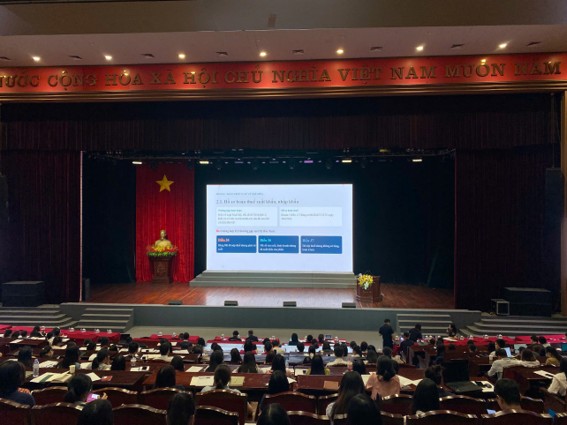
On October 31, 2026, Bac Ninh Customs (under the Regional Customs Sub-department V) held the 2026 Customs–Business Dialogue Conference (2nd edition) at the Kinh Bac Cultural Center, with more than 300 businesses attending. The conference featured four presentation topics (production facilities, prevention of customs violations, tax and revenue accounting, and business data), followed by a live question-and-answer session. A representative of UNI Customs Consulting attended and recorded a number of points that businesses engaged in processing under contract, production of export (SXXK) and export processing enterprises (DNCX) can apply right away. This guidance applies nationwide, so businesses located in other provinces should also take note. UNI has summarized the main points below.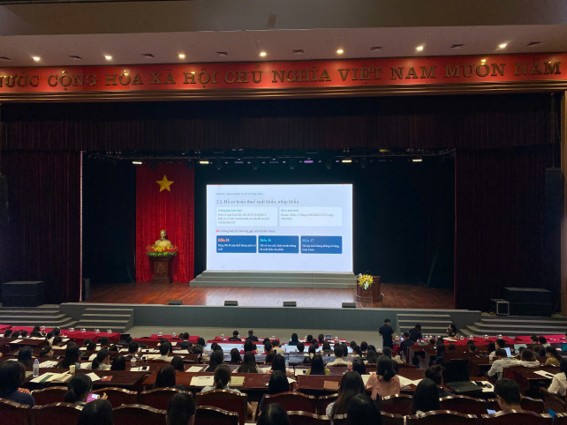
Overview of the 2026 Customs–Business Dialogue Conference organized by Bac Ninh Customs at the Kinh Bac Cultural Center
PART 1. Common Errors and Recommendations from Bac Ninh Customs
1. E31 domestic (local) imports sourced from E62: duties must be paid
E62 products are manufactured from imported materials on which duties have not been paid. Therefore, when they are sold into the domestic market under the E31 type, the business must file a declaration and pay duties. If the business puts the goods into further production and actually exports the finished products, it may claim a customs duty refund under Article 36 of Decree 134/2016.
In its review, Customs found that many businesses have not paid these duties. The Customs Department issued Official Dispatch No. 19322/CHQ-KTSTQ dated July 23, 2026, requesting a review of E31 declarations and the handling of the duties owed.
- Businesses that have received a notice: you should review your own records and pay the duties immediately to avoid a post-clearance audit and late-payment interest that accrues daily.
- Newly established businesses with SXXK status: pay attention from the moment you open your first E31 declaration.
2. Chemical imports and exports: declare every ingredient and apply for permits where required
- When imported, chemicals under Chapter 28 or Chapter 29 must be declared before customs clearance, except for the exemptions in Clause 7, Article 6 of Decree 26/2026/ND-CP.
- The declaration must state the concentration and content of each ingredient in full, so that it can be determined whether the goods require a license or are prohibited.
- Lead and lead compounds have HS codes in Chapter 78 but still fall under Appendix III of Decree 24/2026, so an import license is required.
- For DNCX, the provincial Departments of Industry and Trade currently do not agree on how to interpret the exemption. Customs recommends that DNCX apply for a license to avoid being penalized later.
- Failure to declare chemicals may result in a fine of VND 20–30 million and an order to re-export within 30 days (Decree 275/2026/ND-CP).
3. Temporary import under G12/G13 followed by re-leasing: treated as duty evasion
Machinery temporarily imported for a project is exempt from import duty. If it is leased to another business or to a DNCX without declaring a change of use, the business is fined 1 to 3 times the amount of duty evaded and must pay the full amount of duty (Decree 169/2026/ND-CP).
The full slide deck “Recommendations on Common Errors and Notes for Faster Customs Clearance” presented by Bac Ninh Customs at the conference is available here.
PART 2. Guidance on Notifying Production Facilities (TBCSSX) for Processing under Contract, SXXK and DNCX Businesses
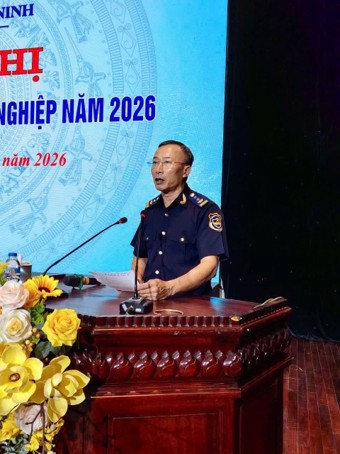
Mr. Vũ Danh Hải, Team Leader of Bac Ninh Customs, speaking at the conference
1. The initial notification must be accepted before the first shipment is imported
The business files Form No. 20 on the System. The initial notification is usually accompanied by an inspection of the production facility. Production capacity is the basis for reconciling the quantity of imported materials, so it must be declared accurately and in line with actual conditions.
| Type | Initial notification timing | Notes |
| Processing under contract | Before bringing in leased or borrowed machinery and equipment (MMTB), or before the first materials arrive | Supplement the MMTB and workforce declaration within 30 days after the goods have been brought in |
| SXXK | Before the first materials arrive | Declare MMTB, workforce and production capacity in full |
| DNCX | Before the first MMTB arrives | Declare at least 30 days before official operations begin; Customs inspects the facility together with the surveillance conditions |
2. Two groups of amendment and supplementary notifications
- Group 1 (notify before the next import shipment): changes to premises, address, production scale, legal representative, conditional business lines, and subcontracting or storage locations.
- Group 2 (periodic notification): all other changes, submitted no later than the 10th day of the first month of the following quarter; the changes made during the quarter may be consolidated into one submission.
- An increase in machinery and equipment (MMTB) or workforce that pushes capacity beyond the scale stated on the Investment Registration Certificate falls under Group 1. If it is unclear which group applies, the business should follow the Group 1 deadline.
3. Common errors when filing supplementary declarations
- Declaring a change without describing the change and without attaching supporting documents.
- Adding a subcontractor or a new production facility but deleting the old information that is still active.
- Explaining that production capacity has reached its maximum while continuing to import more machines and hire more workers.
- A production facility has already been inspected, but its status on the System still shows “Not inspected.”
Bac Ninh Customs reiterated: early notification is not penalized; only late notification or failure to notify is penalized.
The document “Guidance on Notifying Production Facilities” presented by Bac Ninh Customs at the conference is available here.
PART 3. Notes on Tax Accounting
The tax accounting topic explained how to complete payment slips for duties, fines and customs processing fees, how to look up outstanding debts, and how to prepare refund files and handle overpayments. Bac Ninh Customs also pointed out common errors made when making payments and when preparing refund files.
The slides for the “Tax Accounting” topic presented by Bac Ninh Customs at the conference are available here.
PART 4. Answers to Business Questions
The Q&A session focused on notification of production facilities. Below are the questions submitted by businesses and the answers from Bac Ninh Customs.
- A business engaged in processing under contract engages a domestic company to subcontract part of the processing. Must the subcontractor also have its production facility inspected?
Yes. A domestic subcontractor must be inspected and assessed. However, where the subcontractor is a household business (sole proprietorship), Customs may decide whether to inspect it based on risk management.
- A DNCX sells scrap and defective products (phế liệu, phế phẩm) to a domestic environmental company. Must it go through the destruction supervision procedure?
Scrap and defective products may be sold into the domestic market, but they must be declared in the form they actually take. If the goods are still buttons, fabric or a complete garment, they cannot be declared as scrap; the code for that product must be applied and duties calculated accordingly. Only after going through the destruction supervision procedure and actually becoming scrap can the business open a declaration for the sale of scrap.
- If a subcontracting agreement addendum is signed that increases or decreases product codes or quantities, does it fall under Group 1 or Group 2?
Any change relating to a subcontracting agreement falls under Group 1 and must be notified before it is carried out.
- Must the business declare all machinery and equipment (MMTB), or only the MMTB used directly in production?
Declare only the MMTB that directly participates in production; do not submit the entire fixed-asset list (Account 211). In practice, some businesses submitted lists of more than 10,000 lines, including computers, desks and chairs, and generators. The itemized list should also be compiled by quantity rather than by counting row numbers, to avoid having to explain discrepancies when figures differ between filings.
- If actual capacity has increased since Customs inspected the facility but has not yet exceeded the scale stated on the Investment Registration Certificate, does the business need to request a re-inspection?
Customs does not inspect production facilities at a business’s request; it decides based on actual circumstances and risk management information. The business should wait for a response and follow the guidance provided.
- A business has added an external rented warehouse and made other changes to MMTB, workforce and production capacity. Should it update immediately or wait until the end of the quarter?
Customs recommends updating immediately when the change occurs, because early notification is not penalized.
- When a subcontracting agreement expires and the two parties sign an extension addendum, must the business notify again?
Yes. Even if the agreement contains an automatic renewal clause, the System does not renew automatically. The business must update the term on the System before the agreement expires.
- A DNCX adds commercial activities and rents an external warehouse to store commercial goods (A41). Does it have to declare this and wait for a Customs inspection?
A DNCX that wishes to rent an external warehouse must send an official letter with supporting documents to the Regional Customs Sub-department V (Chi cục Hải quan khu vực V) for inspection and assessment, and may move goods into the warehouse only after approval. Notification of production facilities applies only to duty-free and non-taxable goods, so a warehouse that stores only commercial goods does not need to be notified on the System.
- If a business opens an additional new factory, should it file a supplementary declaration or a new registration?
If the new factory is within the same Bac Ninh Customs jurisdiction as the existing facility, the business files a supplementary declaration adding the new facility. If the new factory is outside the area managed by Bac Ninh Customs, the company must file a new production facility notification with the customs office that manages the area where the factory is located.
- What are the risks if a subcontractor has not yet received its production facility inspection result?
A subcontractor must have sufficient production capacity before goods may be transferred to it. If it has not yet been inspected, the business must wait until Customs inspects and confirms before transferring the goods.
- A DNCX engages another business to process goods. Can it send the goods as soon as the declaration is successfully filed, or must it wait for acceptance?
If all supporting documents have been attached as instructed, the business may send the goods from the time the declaration is filed. However, Customs recommends waiting for acceptance so that any missing documents can be supplemented in time.
- If the surveillance camera loses its connection, may the business report on a weekly basis?
No regulation allows weekly reporting. The camera must remain continuously connected, and when a problem occurs the business must notify Customs promptly.
- When extending a processing under contract agreement on the System, must the business also file a supplementary declaration of production facility information?
No. The above applies only to subcontracting. Processing under contract agreements and amending addenda are declared in the usual way.
Businesses may continue to send other questions through the group chat or by email; Bac Ninh Customs will compile them and respond collectively.
UNI Customs Consulting Stands with Your Business
Many topics covered at the conference are tied to import–export–inventory data, material consumption norms and settlement reports, such as reviewing E31 declarations or explaining production capacity. Operating in Vietnam since 2015 and having handled 6,500+ customs settlement reports (BCQT) (as of the end of December 2025), UNI Customs Consulting helps FDI businesses review compliance, identify risks and propose solutions early.
If your business is facing difficulties related to the matters above, please contact UNI right away.
📞 Contact UNI Customs Consulting for free consultation:📧 Email: [email protected]📱 Hotline: (+84) 24-7308-7988 (Hanoi) | (+84) 28-7301-8910 (HCM)