

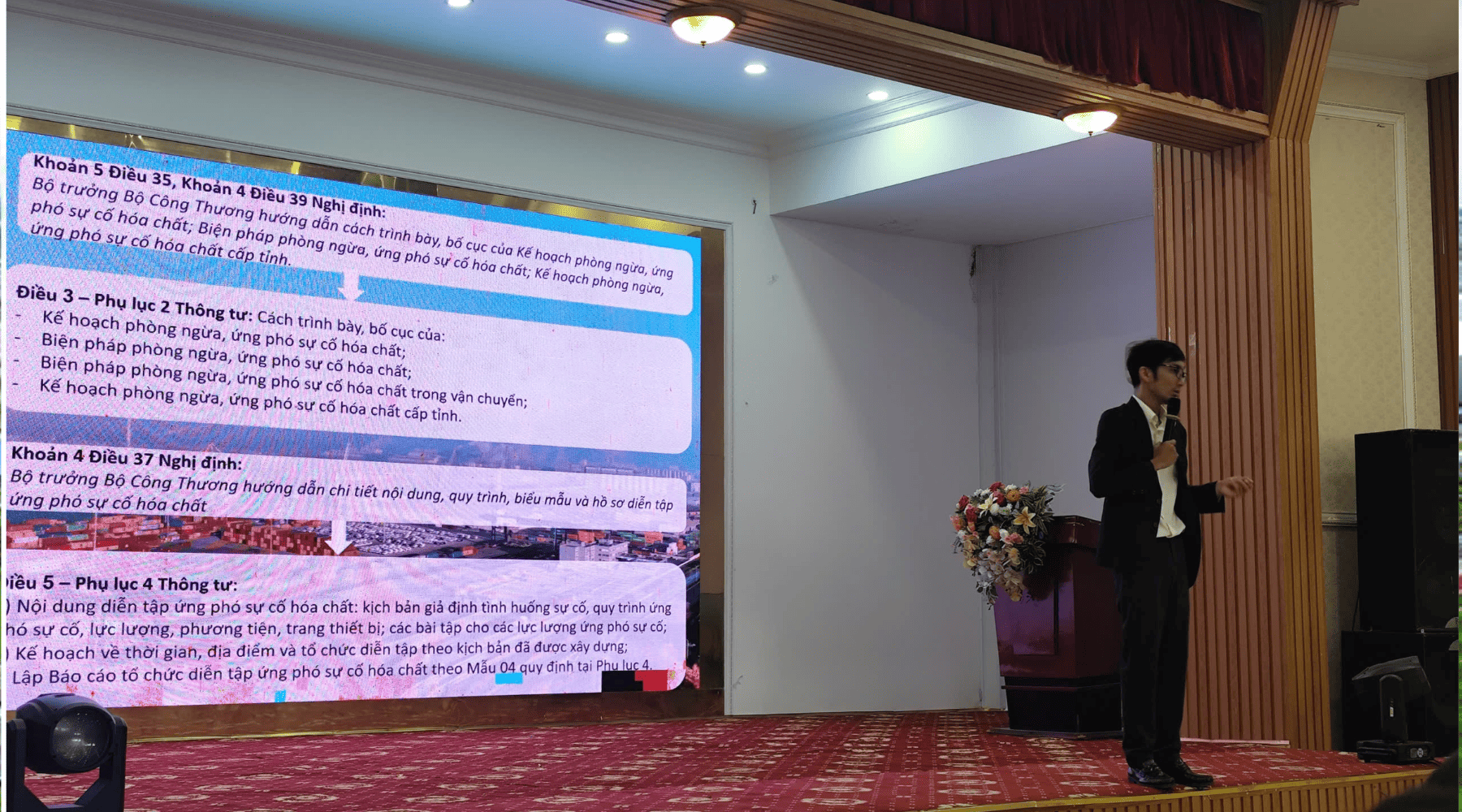
On 18 November 2026, the Hung Yen Provincial Department of Industry and Trade held the 2026 Conference on Dissemination of Laws on Chemical Activities, attended by representatives of the Vietnam Chemicals Agency (Ministry of Industry and Trade) and organizations and individuals engaged in producing, trading, storing, transporting and using chemicals in the province. The conference provided guidance on implementing the Law on Chemicals No. 69/2025/QH15, Decrees 24, 25 and 26/2026/ND-CP and Circulars 01 and 02/2026/TT-BCT, as well as the new rules on decentralization and simplification of administrative procedures under Resolution 19/2026/NQ-CP and Circular 26/2026/TT-BCT.
UNI CUSTOMS CONSULTING attended the conference and summarizes the key points below.
1. KEY ISSUES CLARIFIED AT THE CONFERENCE
a. Exemption from procedures does not mean exemption from regulation
The Chemicals Agency emphasized that the cases under Article 21 of Decree 26/2026/ND-CP and Resolution 19/2026/NQ-CP are only exempt from administrative procedures (certificates, licenses) and are not excluded from the scope of chemical laws. Businesses must still report on the Database, provide safety training, develop incident prevention and response measures/plans, and ensure adequate facilities.
- Household adhesives containing specially controlled chemicals: the law does not distinguish consumer goods from industrial goods by import volume; businesses determine and declare the intended use themselves and bear responsibility for it. If Customs does not accept this, businesses should send a written inquiry to the competent specialized authority;
- Paints and disinfectants with valid circulation registration are exempt from licensing and do not have to be stored in the warehouse of a certified chemical storage service provider, but the storage area must still meet safety requirements and incompatible goods must not be stored together;
- Lubricating oils and greases are chemicals, not petroleum (petroleum refers to products used as fuel), so the exemption for petroleum does not apply;
- Nitrogen generators installed at a factory are considered production, not repackaging for internal use; if owned by the business, a Certificate of Eligibility for chemical production is required.
b. Declaration of intended use and chemical declaration
- Users of conditional chemicals and specially controlled chemicals (including those purchased through intermediaries or domestically) must declare the intended use on the Database, only once before first use, and declare again when the purpose or the chemical changes. Sellers may not sell to users who have not declared; if a sale still takes place, both parties will be penalized;
- The purchase/sale control form for specially controlled chemicals applies to both buyers and sellers; users must keep the forms. Forms may be created on the system, or kept on paper and uploaded with the annual report;
- Export processing enterprises (EPEs) are not automatically exempt from import chemical declaration (Chapters 28 and 29); they are exempt from foreign trade procedures only if located in a separate customs area. Each EPE should clearly determine its own legal status;
- Businesses that purchase products for their own use are not required to disclose information on hazardous chemicals in products (Appendix XIX of Circular 01/2026/TT-BCT); this obligation applies only to manufacturers and importers, and only when a product matches both the chemical column and the product column of the list.
c. Reporting on the specialized Database
- Businesses must report all chemicals used in their operations, including additives, water treatment chemicals and reagents used in small quantities, except for matters involving national defense and security secrets. Products bought as consumer goods (laundry detergent, dishwashing liquid, etc.) do not need to be reported;
- The reporting deadline is 15 February each year; filing even one day late is subject to penalties. The Chemicals Agency recommends updating data quarterly to avoid system overload in January–February;
- Each commercial product needs its MSDS declared only once; updates are needed only when the MSDS changes (create a new commercial product code or email the system administrator to remove the old code).
d. Safety Data Sheets (MSDS)
- MSDS must be in Vietnamese so that workers handling the chemicals can understand them;
- Non-hazardous components may be kept as trade secrets; hazardous components must be disclosed. In import declarations, information must be declared in full according to the MSDS of each shipment, as the composition may vary between shipments;
- Ammonia solution (16–25% NH₃) is in fact NH₄OH and is not regulated as anhydrous NH₃; stating “25% anhydrous NH₃” on an MSDS is substantively incorrect.
e. Warehouses and safety equipment
- Under Clause 5.9 of QCVN 05A:2020/BCT, eyewash and emergency shower equipment must be provided within 17 m of areas storing corrosive chemicals, regardless of the quantity (even at points using only about 500 ml); portable units may be used;
- The number of emergency exits is determined by the warehouse floor area, not by a sense that it is a “small warehouse”; warehouses must have two doors facing two different directions as required by the technical regulation and must also meet fire safety requirements;
- The maximum storage quantity used to determine whether an incident prevention plan is required is calculated across all stages (tanks, pipelines, intermediate equipment), usually based on tank capacity.
f. VNIDCheck traceability portal
- Specially controlled chemicals must be traced on the VNIDCheck portal under Circular 154/2026/TT-BCA of the Ministry of Public Security (issued on 4 September 2026 and already in effect). The portal is managed by the Ministry of Public Security; the Chemicals Agency does not answer questions about it and advises businesses to contact the portal’s hotline;
- According to the portal presenter: the business owner completes electronic identification first and then grants access to staff; shipments must be declared within 10 days of arrival; buyers confirm on the portal; the portal is connected with the Chemicals Agency and Customs but not yet with the Tax authority.
2. KEY DEADLINES TO MONITOR
- When chemical activities change: update the incident prevention and response measures and the issuance decision on the specialized Database (paper filings to the Department of Industry and Trade are no longer required);
- December 2026 (expected): issuance of a Decree amending Decrees 24, 25 and 26/2026/ND-CP to simplify procedures, expected to take effect from 1 March 2027;
- By 31 January each year: report on the production, import, use and storage of banned chemicals in the previous year;
- By 15 February each year: update the previous year’s chemical activities on the specialized chemical Database;
- From 1 July 2026: the rules on issuing Certificates of Eligibility for chemical storage services apply;
- 31 December 2026: deadline to comply with the requirements for chemicals newly added to the lists that businesses are already handling;
- 31 December 2027: Certificates of Eligibility for the production and trading of conditional chemicals issued before 17 January 2026 expire.
Businesses must also keep records on hazardous chemicals for at least 3 years from the date their activities involving the chemical end.
3. KEY TAKEAWAYS FOR BUSINESSES
| ▌1. Legal & Records
• Review certificates and licenses (correct location, scale and chemicals); certificates issued before 17 January 2026 are valid only until 31 December 2027. • Prepare a Vietnamese MSDS for each commercial product; disclose all hazardous components. • Keep records on hazardous chemicals for at least 3 years; keep purchase/sale control forms for specially controlled chemicals. |
▌2. Digitalization & Reporting
• Declare imported chemicals (Chapters 28, 29) via the National Single Window before customs clearance. • Update the previous year’s chemical activity report on the specialized Database by 15 February each year. • Declare the intended use of conditional and specially controlled chemicals before first use. • Trace specially controlled chemicals on the VNIDCheck portal. |
▌3. Safety & Personnel
• Appoint a chemical safety officer with the required qualifications (Appendix III of Decree 25/2026/ND-CP). • Store no more than the quantities stated in the incident prevention and response measures/plan; update them when activities change. • Provide chemical safety training every 2 years; facilities required to have a plan must hold incident response drills annually. • Install eyewash and emergency shower equipment within 17 m of corrosive chemical storage areas. |
Related Service: Chemical Services
📞 Contact UNI Customs Consulting for free consultation:📧 Email: [email protected]📱 Hotline: (+84) 24-7308-7988 (Hanoi) | (+84) 28-7301-8910 (HCM)