


Free Trade Agreements (FTA) have transformed Vietnam’s economic landscape, creating unprecedented opportunities for businesses to expand internationally. With 16 FTAs currently in force, Vietnam has positioned itself as a key player in global trade networks. This comprehensive guide explores how Vietnamese enterprises can leverage these agreements to reduce costs, attract investment, and access new markets. Whether you’re an established exporter or just beginning to explore international trade, understanding Vietnam’s FTAs is essential for business growth in today’s interconnected economy.
1, What is a Free Trade Agreement?
A Free Trade Agreement (FTA) is a pact between two or more countries that aims to reduce barriers on the exchange of goods and services across their borders.
This free trade policy facilitates international trade by significantly reducing or eliminating government-imposed restrictions such as:
- Tariffs
- Quotas
- Subsidies
- Prohibitions
2, Vietnam’s Current Free Trade Agreements
As of August 2023, Vietnam has 16 Free Trade Agreements in force:
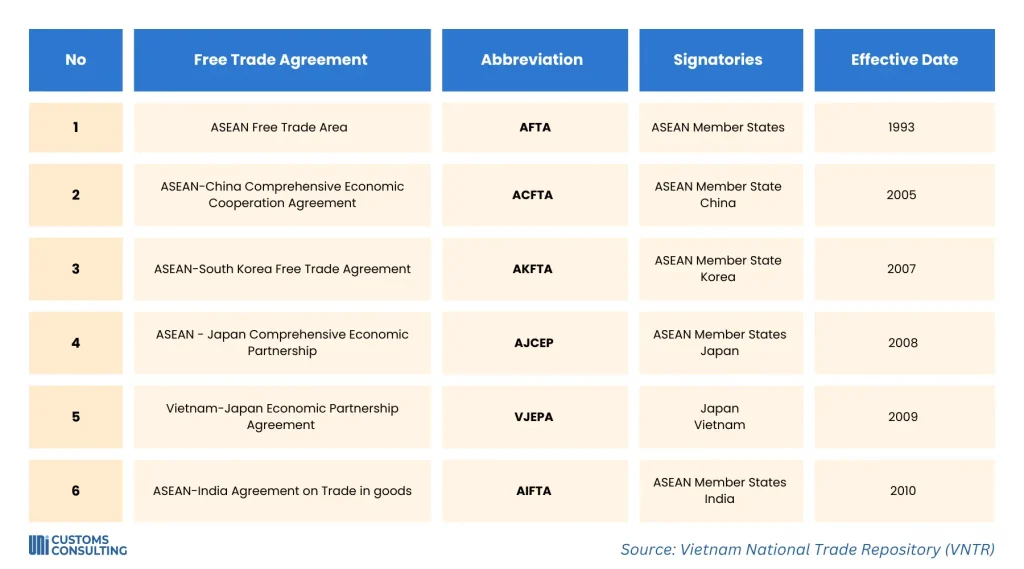

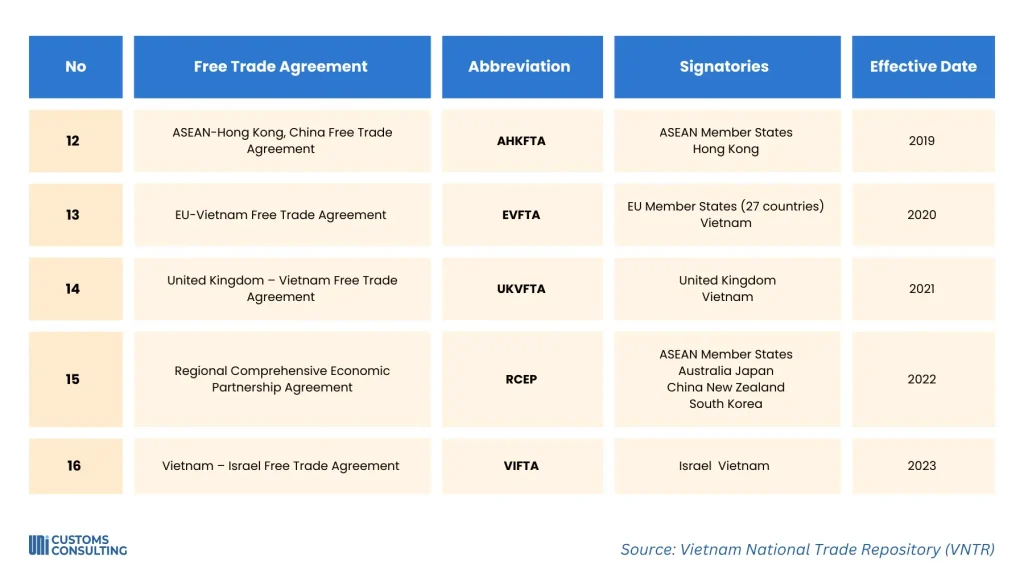
3, Key Benefits of FTAs for Vietnamese Businesses
a, Reduced Production Costs
FTAs have significantly lowered the cost of imported raw materials, often below domestic production costs. This cost reduction:
- Helps minimize production expenses
- Enables Vietnamese businesses to integrate into global supply chains
- Enhances price competitiveness of Vietnamese goods
- Diversifies product ranges
- Stimulates domestic production for export purposes
Additionally, these agreements create new opportunities for small and medium-sized enterprises (SMEs) to access international markets, fostering innovation across various industries.
b, Increased Foreign Direct Investment (FDI)
FTAs include commitments to treat domestic and foreign investors equally, which has:
- Attracted significant direct investment from foreign businesses
- Created numerous opportunities for international collaboration
- Enhanced technology transfer to Vietnamese companies
Furthermore, sustainability principles in new-generation FTAs have encouraged businesses to adopt cleaner, renewable, and environmentally friendly production methods.
c, Expanded Consumer Markets
Most FTA provisions require member countries to:
- Open new markets for trade partners
- Create favorable conditions for goods exchange
- Reduce tariffs progressively
As FTAs enter deep tariff reduction phases, Vietnamese exports are expected to grow substantially. With preferential tariff access to new markets, Vietnamese products gain competitive advantages and reach a wider consumer base.
4, How Vietnamese Businesses Can Leverage FTAs
a, Obtaining a Certificate of Origin (C/O)
One of the most effective ways for businesses to benefit from FTAs is by obtaining a Certificate of Origin (C/O). Products with a valid C/O enjoy preferential or zero tariffs when imported into FTA partner countries, significantly reducing costs and increasing price competitiveness.
–> Relevant topic: What is a Certificate of Origin?
Step-by-Step Process for Obtaining a C/O:
Step 1: Define the criteria of origins for your goods
Each FTA includes specific rules of origin. Companies must:
-
- Identify the HS code (Harmonized System code) for their products
- Cross-reference this code with the Product-specific rules in the relevant FTA
Common criteria include:
-
- Wholly Obtained (WO) criterion
- Regional Value Content (RVC) criterion
- Change in Tariff Classification (CTC) criterion
- Specific Process (SP) criterion
Step 2: Prepare required documentation
Gather all necessary documents, including:
-
- Application for Certificate of Origin
- Certificate of Origin form
- Commercial Invoice
- Export customs declaration
- Packing list
- Bill of Lading
- Production Process documentation
Step 3: Submit your application online
-
- Register and declare information on the Ecosys system (licensed by the Ministry of Industry and Trade) or Comis system (licensed by VCCI)
- Upload scanned versions of all required documents
- Wait for initial review and business registration number
Step 4: Complete the submission process
-
- Submit physical documents directly to the Ministry of Industry and Trade or VCCI
- Wait for approval, stamping, and issuance of the C/O
b, Staying Updated on Legal Regulations
To maximize FTA benefits, businesses should:
- Research tariff preferences applicable to specific products
- Understand regulations on reduced import duties, export tax exemptions, and VAT refunds
- Gain comprehensive knowledge of rules of origin and import quotas
- Regularly monitor customs updates from official websites and business associations
- Adapt business strategies to changes in international trade regulations
Expert Support for FTA Utilization
With years of specialized experience in international trade facilitation, UNI Customs Consulting provides comprehensive consulting services for Vietnamese businesses looking to leverage FTAs effectively. Our experts can guide you through:
- Identifying applicable FTA benefits for your products
- Completing C/O application procedures
- Ensuring compliance with all relevant regulations
- Optimizing your supply chain for maximum FTA advantages
Ready to maximize your FTA benefits? Contact UNI today for personalized support tailored to your business needs.
📞 Contact UNI Customs Consulting for free consultation:
📧 Email: uni@eximuni.com
📱 Hotline: +(84) 908-535-898 (Vietnamese) | +(84) 902-927-767 (Korean)