


During customs audit, businesses that cannot provide proper explanations to Customs authorities face tax recovery, administrative penalties, and even criminal prosecution. Many import-export businesses are urgently seeking solutions for these inspections. What about your business? The following article will help you understand common mistakes, processes, and practical solutions from UNI Customs Consulting.
You can learn about the subjects of inspection and the timeline for customs audit in the following article:
Read More >>> What is Post Clearance Audit? Procedures, Timeline, and Required Documentation >>>
1.Potential consequences if businesses cannot provide proper explanations
a. Tax recovery and late payment interest
- Recovery of import duties, VAT, special consumption taxes (if applicable)
- Late payment interest: calculated at 0.03% per day on the amount of recovered tax (applied for each day of delay from the date the payment should have been made)
- Business owners may be temporarily banned from leaving the country if tax obligations and penalties are not fulfilled.
Example: A business is subject to tax recovery of 500 million VND, accrued after 180 days from the time the tax obligation arose → late payment interest can reach 27 million VND (500 million × 0.03% × 180)
b. Administrative penalties
-
- Unable to provide appropriate C/O → recovery of preferential tariffs and penalties
- Applied according to Decree 128/2020/ND-CP
- Penalty rate: 10% to 20% of the recovered tax amount, depending on the nature and severity of the violation (intentional or unintentional, first-time or repeat offense…)
Examples:
- Incorrect HS code declaration affecting taxes → recovery and 10-20% penalty
- Unable to provide appropriate C/O → recovery of preferential tariffs and penalties
c. Stricter future inspections due to reduced compliance rating
Businesses with recorded violations will be assessed as having low compliance levels under the 2014 Customs Law. Consequences include:
- Increased frequency of red channel classification, physical inspection of goods
- Priority inclusion in customs inspection lists for subsequent years
- Difficulties in preferential procedures (AEO priority businesses, tax refunds, tax exemptions…)
- Loss of opportunity to be considered for priority business status (AEO) for at least 2 years
d. Serious cases: Potential criminal prosecution
- Case transfer to investigative agencies if tax evasion exceeds 100 million VND or for repeat offenses
- Criminal prosecution under Article 188 – Tax Evasion with penalties:
-
- Fines up to 1 billion VND
-
- Imprisonment from 3 months to 7 years (depending on the severity of the violation)
- Ban from holding positions or practicing professions for 1-5 years
2. Common violations businesses typically make:
With over 8 years of experience advising and supporting import-export businesses through customs audit, we have compiled the common violations that businesses frequently make. Below are the typical violations:

a. Issues related to the management of processing materials, export production, and export processing enterprises
- Incorrect final settlement reports
- Incorrect declaration of actual norms
- Failure to separate material sources
- Mismatched declaration codes and internal codes
- Misuse of processing materials and export production materials
b. Documentation, paperwork, and certification issues:
- Missing C/O documentation, rejected C/O (Certificate of Origin)
- Missing import permits
- Missing documentation for conditional chemical imports, restricted chemicals, industrial precursors
- Missing quality inspection certificates
- Missing fire safety certificates, environmental impact reports
c. Declaration issues:
- Incorrect HS codes (product classification codes)
- Failure to declare chemicals
- Incorrect customs declaration forms
- Incorrect determination of customs value
d. Other common issues:
- Errors in import-export tax declarations and related taxes
- Mistakes in business inspection and monitoring processes
- Failure to maintain complete documentation as required (typically for 5 years)
- Complications in applying tax preferences under trade agreements
3. Difficulties that make it “hard” for businesses to respond to Customs authorities
Based on our consulting experience with many businesses, we’ve identified these obstacles that make it difficult for businesses to “self-inspect” and provide effective explanations.
a. Lack of understanding of the Customs Audit process
- Should the inspection take place at the business headquarters or at the Customs Sub-department?
- Is it mandatory to sign daily working minutes?
- When should responses be in writing? When can businesses request clarification?
b. Companies are unclear about the inspection content
Businesses only see the term “Customs Audit” on the notification and become anxious, unsure whether the inspection covers all business issues or only specific themes (HS Code, valuation, C/O…).
c. Lack of expertise to provide explanations
- Don’t understand how to link data across departments
- Misunderstand the relationship between Invoices and international payment documents
- Lack knowledge of Customs laws, export taxes, import taxes, etc.
- Lack understanding of principles regarding HS code classification, chemical declaration and import, etc.
- Unfamiliar with regulations on record storage and management for Customs Audit under Customs Law and Circular 38/2015 (and amendment 39/2018)
d. Lack of legal knowledge for negotiation and penalty appeals
- Lack understanding of how to identify violations, determine violation severity, and penalty rates according to regulations.
- Lack understanding of administrative violation penalty principles leading to higher penalties than required by regulations.
e. Difficulty distinguishing between “valid” and “risky” documentation
- Self-constructed production norms without clear basis
- Some input invoices are missing or payment documents don’t match invoices
- Declared values “referenced from partners” without sufficient basis
4. Tips to help businesses successfully navigate customs audit
a. Documentation that businesses need to prepare
| Document Group | Specific Documents |
| Import-export related documents | Detailed reports of goods on import-export declarations, List of canceled declarations, … |
| Warehouse and materials management | Details of raw material warehouse inputs/outputs, Details of finished product warehouse inputs/outputs |
| Accounting and Finance | Extracted detailed data from accounting account ledgers, … |
| Production and processing | Documents related to disposal/changes in purpose of use, … |
| Inspection and audit | Final settlement reports, inspection and audit decisions, … |
📥 [Download the free document list here]
Note: Businesses need to prepare all original documents, copies, arrange them in order, and clearly categorize them for convenient inspection. Thorough preparation helps ensure smooth and effective work with the inspection team.
b. Customs Audit process at business headquarters
This is an inspection form conducted directly at the business facility, allowing customs authorities to comprehensively assess documents, records, and actual operations. The inspection process includes the following steps:
- Inspection notification: Customs authorities send written notification at least 05 working days in advance regarding the time and content of the inspection.
- Issuance of inspection decision: At the first working session, the inspection team will announce the Customs Audit Decision and explain the purpose, scope, and duration of the inspection.
- Business representative: The business appoints authorized representatives and relevant responsible individuals (accounting, import-export, warehouse, production) to work directly with the inspection team.
- Conducting the inspection at the business headquarters:
- Review and cross-check customs and accounting documents and records.
- Physical inspection of warehouses, production processes, and relevant departments to verify information and data.
- Inspection and data collection from departments: Accounting, Import-Export, Logistics, Production.
- Preparing inspection minutes: After completing the inspection, the team will prepare minutes recording the results and findings.
- Issuing conclusions and processing: Customs authorities issue Inspection Conclusions and proceed with processing violations (if any) according to legal regulations.
5. Supporting Businesses Through Customs Audit – Comprehensive Solutions from UNI Customs Consulting
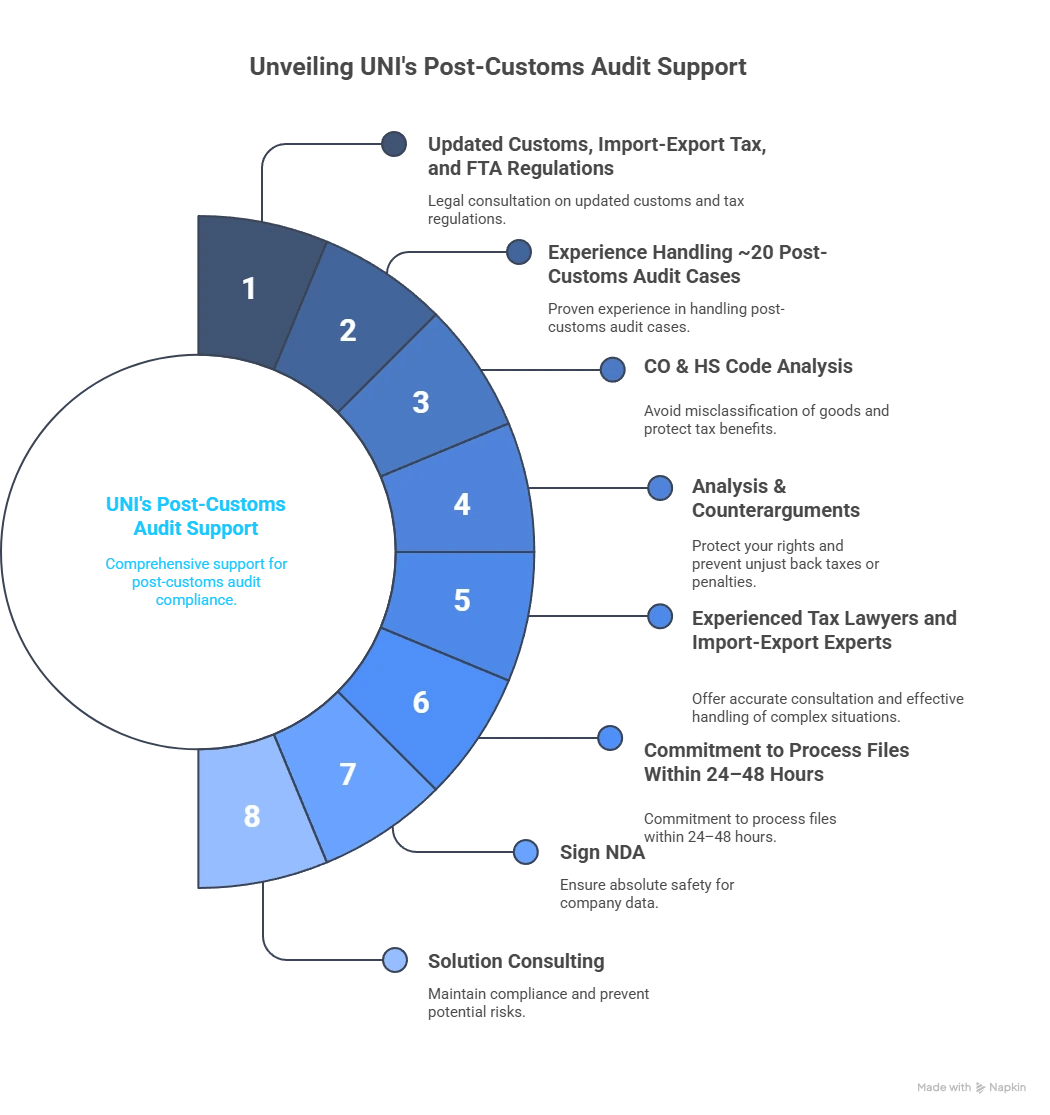
UNI Customs Consulting accompanies businesses from document preparation to completion of customs audit, ensuring compliance and transparency. We are confident in our two-phase approach, helping businesses pass inspections most effectively.
a. Proactive Support: Pre-audit Assessment
- Receiving and analyzing all relevant business data.
- Helping businesses complete and organize missing or invalid documents and records.
- Conducting detailed inspection simulations according to customs standards, including:
-
- Review of final settlement reports.
-
- Review of record-keeping logs and business data
- Providing detailed reports on identified issues, root causes, and comprehensive remedial solutions.
This helps businesses build confidence when facing actual inspections while minimizing risks of tax recovery and administrative penalties.
b. Reactive Support: During and After Receiving Customs Inspection Notifications
- Analyzing inspection content.
- Identifying business risks.
- Advising on specific action plans:
-
- Building persuasive explanations that comply with regulations.
-
- Guiding the preparation and scientific arrangement of supporting documents.
-
- Guiding business representatives on skills and working experience
With over 9 years of experience, UNI has successfully supported 20 FDI, processing, and export processing enterprises in providing successful explanations, minimizing financial losses. We work directly with both Customs Departments (60%) and local Sub-departments (40%), accumulating practical experience. Over 80% of our customers renew contracts and choose UNI as a long-term strategic partner. This is clear evidence of our superior quality in customs audit services.
Complex Issues UNI Has Successfully Resolved:
- Explaining discrepancies between actual figures and documentation
- Explaining certificate of origin (C/O) documentation
- Explaining HS codes for imported goods
👉 See details of actual case studies UNI has resolved
CUSTOMS AUDIT CAN COST YOUR BUSINESS BILLIONS OF VND!
Even a small mistake can cause your business to face tax recovery and penalties amounting to billions of VND. This inspection could be a “major blow” to your finances if not prepared in time. Contact UNI today to protect your business before it’s too late!
📥 To receive a free list of required documents and learn more about our services, please click here [Document Checklist]
📞 Contact UNI Customs Consulting for free consultation:
📧 Email: uni@eximuni.com
📱 Hotline: +(84) 908-535-898 (Vietnamese) | +(84) 902-927-767 (Korean)