


In the context of global integration, Vietnam has signed a Free Trade Agreement with the EU (EVFTA), opening up access to a market of nearly 450 million people with a GDP accounting for about 15% of global output. So, what is EVFTA? How can Vietnam turn these great opportunities into sustainable competitive advantages? Let’s find out in the article below.
1. What is EVFTA? A Golden Opportunity for Vietnamese Businesses to Reach Europe
The EVFTA (EU-Vietnam Free Trade Agreement) is a new-generation free trade agreement between Vietnam and the European Union (EU), which includes 27 countries:
Austria, Belgium, Bulgaria, Croatia, Cyprus, Czech Republic, Denmark, Hungary, Estonia, Greece, Germany, France, Ireland, Finland, Italy, Latvia, Lithuania, Portugal, Malta, the Netherlands, Luxembourg, Poland, Slovakia, Romania, Spain, Slovenia, Sweden.
Effective from August 1, 2020, the EVFTA presents tremendous opportunities for Vietnamese small and medium-sized enterprises (SMEs) to penetrate the European market—Vietnam’s 4th largest export destination.
Thanks to the EVFTA, Vietnamese companies benefit from unprecedented tariff incentives and commitments, opening up a “highway” for export growth, foreign investment attraction, and Vietnam’s sustainable economic development.
Read more: What are Free Trade Agreements (FTAs) in Vietnam Business Context: How to Take Advantage?
2. Key Commitments and Scope of the EVFTA
The main pillars of the EVFTA include tariff reduction, liberalization of services and investment, and rules of origin.
a. Tariff Reduction Commitments
The EVFTA commits to eliminating nearly 100% of import tariffs between the two parties over a short timeframe.
For the EU:
-
Immediately removes 85.6% of tariffs on imports from Vietnam (covering 70.3% of Vietnam’s exports to the EU).
-
Eliminates 99.2% of tariffs after 7 years.
For Vietnam:
-
Immediately removes 48.5% of tariffs on imports from the EU (equivalent to 64.5% of import value).
-
Eliminates 98.3% after 10 years.
(Source: Department of Multilateral Trade Policy – EVFTA Tariff Commitments)
b. Liberalization of Services and Investment
The EVFTA significantly opens up the services and investment sectors, covering areas such as finance, telecommunications, distribution, transportation, and investment protection.
According to the European Commission, the EVFTA will “open Vietnam’s market for EU service exports, such as in transportation and telecommunications.” The agreement also encourages removing technical barriers and streamlining procedures while ensuring intellectual property protection and access to public procurement markets.
(Source: Access2Markets – EU-Vietnam Free Trade Agreement)
c. Rules of Origin
To enjoy tariff preferences, goods must prove their origin. Vietnam and the EU have agreed to use the EUR.1 Certificate of Origin (C/O).
From August 1, 2020, the following applies to Vietnamese exports to the EU:
-
For shipments under €6,000: companies may self-certify origin.
-
For shipments over €6,000: a EUR.1 C/O must be issued by a competent authority in Vietnam. The application process is conducted via the National Single Window Portal (Ecosys).
Exported goods must be classified by HS codes to determine eligibility for EVFTA preferences. Businesses must also prepare invoices, customs declarations, material origin documentation, and production records to support the C/O application.
3. EVFTA Achievements and Challenges in the Vietnamese Market
3.1. Achievements
According to Vietnam Customs, trade between Vietnam and the EU has grown strongly. In the first 11 months of 2024, total bilateral trade reached $62.6 billion, up 16.7% year-on-year. The EU is now Vietnam’s 4th largest trading partner, with a trade surplus of about $32 billion over 11 months.

a. Which sectors benefit from the EVFTA?
After nearly 5 years of implementation, the EVFTA has brought significant export gains for Vietnam in:
Traditional sectors:
-
Coffee: $1.9 billion (+50.4%)
-
Cashews: $771 million (+22.2%)
-
Pepper: $215 million (+99.4%)
-
Rubber: $128.7 million (+74.3%)
Other sectors:
-
Computers, electronics, components: $7.8 billion (+55.5%)
-
Machinery, equipment: $6.4 billion (+25.9%)
-
Footwear: $5.18 billion (+18%)
-
Textiles & garments: $3.85 billion (+11.6%)
(Source: European-American Market Department – Vietnam-EU Trade Review, Issue 4/2024)
b. Challenges
Despite promising results, many challenges remain:
-
Lack of knowledge: Many businesses have only general knowledge of EVFTA. According to VCCI, many companies “lack deep understanding of the agreement, industry-specific details, tariff schedules, or non-tariff barriers,” which limits their ability to utilize benefits fully. Only about 20% of exports currently use EVFTA-origin certification.
-
Complicated procedures: Administrative hurdles remain. Common issues include licensing, C/O documentation, and HS code classification.
-
Stringent EU standards: EU’s high technical standards and strict origin rules demand excellent product quality and traceability. VCCI experts note that “EU is a very demanding market,” requiring businesses to “understand regulations, anticipate challenges, and prepare properly.”
For example, the EU’s new EUDR (EU Deforestation Regulation)—effective 2025—will impose strict rules on agricultural and forestry products. Exports like seafood, coffee, and cashews must now meet higher food safety, sustainability, and traceability standards.
4. How to Benefit from the EVFTA? A Guide for Businesses
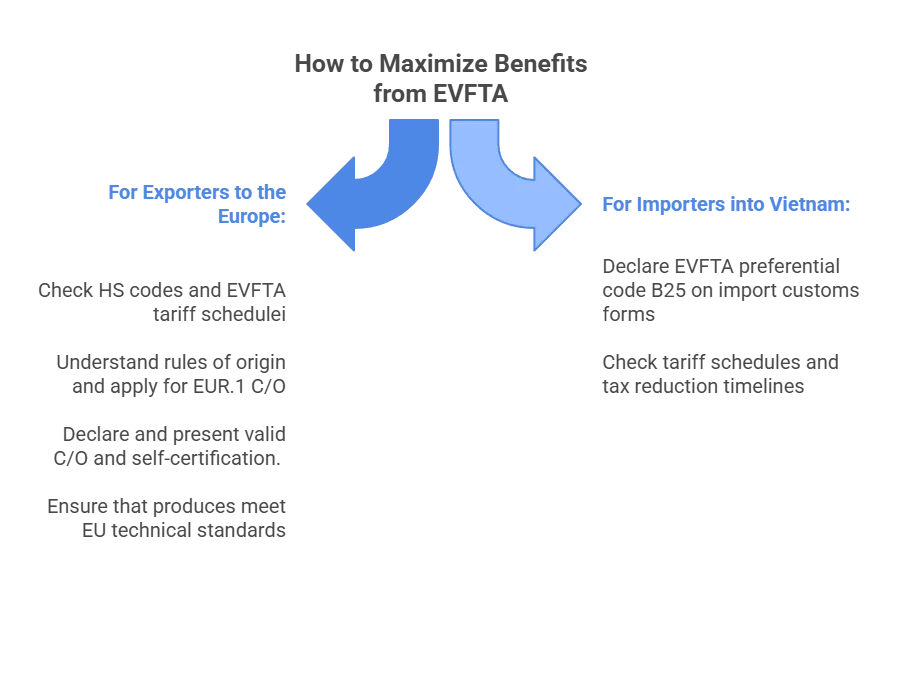
To maximize EVFTA benefits, businesses should proactively implement the following strategies:
a. For Exporters to the EU:
Check HS codes and EVFTA tariff schedules: Determine the 8-digit HS code of your product and look up the EVFTA tariff schedule via the Ministry of Industry and Trade or Vietnam Customs. EVFTA eliminates nearly all tariffs.
Understand rules of origin and apply for EUR.1 C/O:
-
-
For exports above €6,000:
-
Apply for EUR.1 C/O through the competent authority (Ministry of Industry & Trade or authorized agency).
-
Required documents: commercial invoice, export declaration, packing list, and raw material records.
-
Use the National Single Window Portal (www.ecosys.gov.vn) to submit applications.
-
-
For exports under €6,000:
-
Self-certify origin on invoices or commercial documents.
-
Must still declare and retain relevant records.
-
-
Comply with origin and technical requirements:
-
-
Declare origin clearly on customs forms.
-
Present valid C/O or self-certification if required.
-
Meet EU technical standards, including:
-
-
Quality inspection, food safety certification, energy labeling.
-
Labels in English or EU language.
-
For agriculture: comply with EUDR, traceability, organic/eco-friendly standards if possible.
-
b. For Importers into Vietnam: Reduce Costs via EVFTA
- Declare EVFTA preferential code
-
Declare EVFTA preferential code B25 on import customs forms.
-
(Source: Official Dispatch 6283/TCHQ-TXNK 2020)
-
-
Obtain valid EU-origin certification:
-
Via the EU’s REX self-certification system, or
-
EUR.1 C/O issued by EU exporters.
-
-
Check tariff schedules and reduction timelines:
Review EVFTA tariff appendices (per Decree 111/2020 and Decree 116/2022) to plan import schedules and negotiate input material prices effectively.
5. UNI Consulting – Your Strategic Partner for EVFTA Utilization
While EVFTA offers vast benefits, effective utilization requires expert guidance. UNI Consulting is a trusted, specialized international trade and customs consulting firm committed to supporting Vietnamese businesses.
a. Experienced Experts
Our experienced team offers end-to-end support, including HS code classification, rules of origin verification, EUR.1 C/O application, and customs procedure guidance.
From advanced auto parts to traditional household goods, UNI Consulting has successfully “unlocked” C/O EUR.1 certification for various industries. We understand EU market nuances and complex origin requirements.
b. Comprehensive Consulting Services
-
Technical and safety standards consulting:
We provide in-depth guidance to meet EU standards and prepare compliant documents and labeling. -
Updated information and market insights:
UNI delivers timely updates on trade policies, EVFTA tariff changes, and suggests niche EU markets for your products.
c. Long-term Commitment
UNI Consulting is your reliable partner in overcoming regulatory and technical barriers, helping you unlock EVFTA’s “golden opportunity” and thrive in the EU market.
References:
-
Eurostat – The EU represented 15.2% of the world’s GDP in 2021 – May 30, 2024
-
Vietnam Ministry of Industry and Trade – Challenges in the implementation of the EVFTA and the timely involvement of the Ministry of Industry and Trade – May 11, 2023
-
Multilateral Trade Policy Department, Ministry of Industry and Trade – EU-Vietnam Free Trade Agreement (EVFTA)
-
Access2Markets – EU-Vietnam Free Trade Agreement
-
European–American Market Department – Vietnam–EU Trade Bulletin, Issue 4/2024
-
Vietnam Chamber of Commerce and Industry (VCCI) – The EVFTA is not a ‘magic wand’ if businesses cannot overcome barriers
-
European Commission – Implementation of the EU Deforestation Regulation
📞 Contact UNI Customs Consulting for free consultation:
📧 Email: uni@eximuni.com
📱 Hotline: +(84) 908-535-898 (Vietnamese) | +(84) 902-927-767 (Korean)