


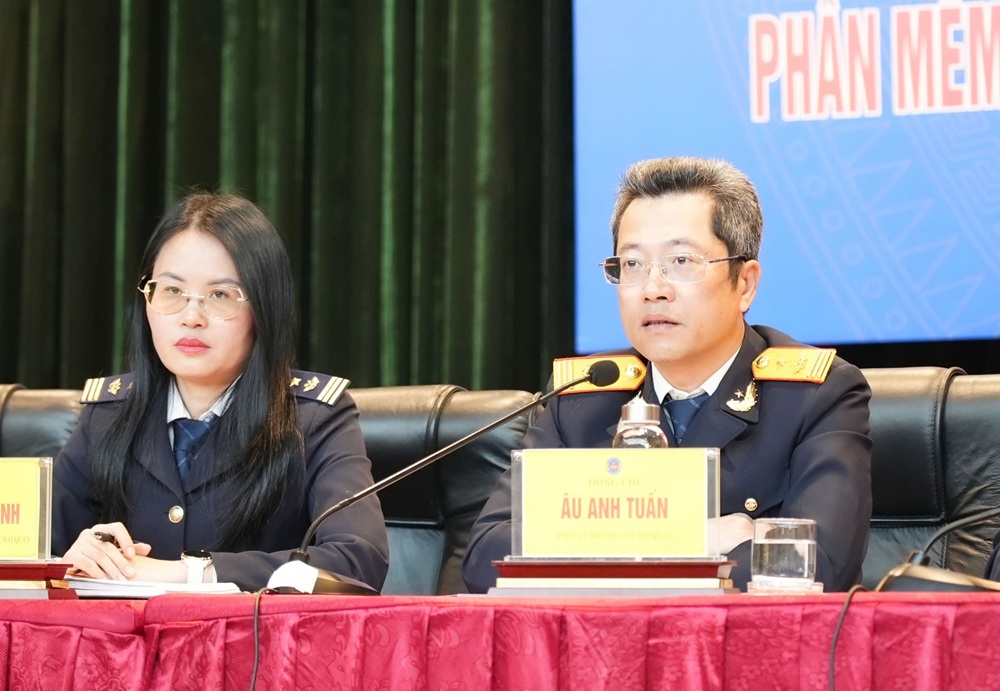
On 2026.01.14, at the headquarters of the Customs Department (Hanoi), the Conference titled “Training and Introduction of Decree No. 167/2025/ND-CP and Circular No. 121/2025/TT-BTC” was held with the participation of a large number of representatives from the business community.
The Conference was chaired and attended by senior leaders, including:
– Mr. Au Anh Tuan – Deputy Director of the Customs Department
– Ms. Mai Thi Van Anh & Mr. Dao Duy Tam – Representatives of professional units under the General Department of Customs.
In the context of significant amendments to regulations on customs procedures and import–export activities, UNI Customs Consulting appointed representatives to attend the Conference in person to update information and participate in discussions, aiming to clarify practical issues that directly affect enterprises’ production and business operations.
Below is a summary of the key contents of the Conference:
PART I: INTRODUCTION OF CORE CHANGES IN THE NEW REGULATIONS
1. Key highlights of Circular No. 121/2025/TT-BTC:
– Summary document issued by the Customs Department: see here
– Summary document prepared by UNI Customs Consulting: see here
2. Key highlights of Decree No. 167/2025/ND-CP:
– Summary document issued by the Customs Department: see here
PART II: DISCUSSION & CLARIFICATION OF PRACTICAL ISSUES

At the Conference, UNI Customs Consulting, together with the business community, raised many practical questions. The Customs Department provided responses and guidance as follows:
1. Issues related to Priority Enterprises (AEOs)
1.1. Does the mechanism allowing goods to be delivered first and customs declaration to be made later, with one declaration for multiple deliveries, applicable to AEOs only apply to on-the-spot import and export? In cases of normal trading transactions with AEOs (not on-the-spot import/export), can this mechanism be applied?
Legal basis: “Article 86: On-the-spot import and export customs procedures
6. In case the customs declarant is a priority enterprise and its partners engage in trading, trading, processing, leasing, borrowing, freight forwarding activities with the priority enterprise, and have on-the-spot imports and exports delivered and received many times within a certain period of time under a contract/order with the same buyer or seller, they shall be entitled to deliver and receive goods first, customs declaration later”
*Question from UNI Customs Consulting
Guidance of the Customs Department:
The mechanism allowing delivery prior to customs declaration for AEOs under Article 86 only applies to on-the-spot import and export. Normal trading transactions (not on-the-spot) are not eligible, except for certain special goods stipulated in Article 93 (e.g., electricity)
1.2. Can an AEO importing goods from a bonded warehouse apply the mechanism of multiple deliveries with a single customs declaration under Article 86?
Guidance of the Customs Department:
Goods imported from a bonded warehouse by an AEO are not considered on-the-spot import/export. Therefore, under the new provisions of Circular No. 121/2025/TT-BTC, this mechanism of delivery prior to customs declaration is not applicable.
1.3. Regarding the notification of contracts/orders prior to the first delivery for AEOs conducting on-the-spot import/export procedures under Clause 6, Article 86, please provide guidance on the notification form. Additionally, in cases where enterprises have a very large number of daily purchase orders, it is proposed that AEOs be allowed to notify only minimal information to reduce administrative burdens.
Guidance of the Customs Department:
The Customs Department acknowledged the proposal to simplify declaration information. It is expected that guidance will be issued allowing AEOs to notify only framework contracts (master contracts) for multiple deliveries, instead of notifying each individual purchase order, in order to optimize procedures for enterprises
2. Issues related to Export Processing Enterprises (EPEs)
2.1. Does the obligation to notify information on the corresponding completed on-the-spot import declaration apply only to on-the-spot import/export under processing and export manufacturing regimes, or to all types of on-the-spot import/export declarations?
Legal basis:
“Article 86: On-the-spot import and export customs procedures
5. Customs procedures
a. Responsibilities of exporters
a.5) Within 15 days from the date of customs clearance of on-the-spot exported goods, the exporter shall notify information on the corresponding on-the-spot import declaration that customs procedures have been completed to the customs authority according to Articles 10 and 12 of Decree 134/2016; amended in Decree 18/2021”
*Question from UNI Customs Consulting
Customs Guidance:
Corresponding on-the-spot import/export declarations apply only to enterprises engaged in processing or export manufacturing activities with on-the-spot import/export transactions, and not to other regimes. Accordingly, the notification requirement applies only to on-the-spot import declarations under processing (GC) and export manufacturing (SXXK) regimes
2.2. When a domestic enterprise hires an EPE to conduct processing, the hiring enterprise must declare the processing facility and processing contract. Is the EPE receiving the processing required to carry out any customs declaration procedures?
Guidance of the Customs Department:
The EPE is not required to carry out customs procedures (pursuant to Article 76). The responsibility for notifying the production facility and processing contract lies with the domestic enterprise.
2.3. Under the regulations, an EPE must complete customs supervision conditions within 30 days from commencement of operations. If the EPE fails to meet these conditions within the prescribed time limit, how will it be handled?
Guidance of the Customs Department:
In principle, an enterprise enjoys EPE status from the time it is granted the Investment Registration Certificate (IRC). Subsequently, the Customs Authority will inspect customs supervision conditions. If the conditions are not met, the enterprise has one year to complete the required EPE conditions.
Detailed procedures for inspection of customs supervision conditions are stipulated in Article 57 of Circular No. 121/2025/TT-BTC.
2.4. An EPE leases empty containers from domestic enterprises to store materials and products for production. Is the EPE required to carry out customs procedures in this case? What is the maximum leasing duration?
Guidance of the Customs Department:
As this constitutes a leasing/borrowing transaction between a domestic enterprise and an EPE, customs procedures are still required
Legal risk note: When negotiating contracts, EPEs should require the lessor (domestic enterprise) to clarify ownership and legal status of the containers:
– If the containers are temporary imported circulating containers (not owned by the lessor): they may only be used as transport containers and may not be leased for storage without conversion of use purpose and full tax payment. Improper leasing may expose both parties to administrative penalties.
– If the containers are owned by the domestic enterprise: leasing is permissible, provided that temporary import–re-export declarations for leasing are completed
2.5. An EPE imports materials to manufacture cameras. If the enterprise changes the use purpose by re-exporting goods abroad, how should procedures be carried out? What if some semi-finished products have undergone simple processing (e.g., coating)?
Guidance of the Customs Department:
According to the amendment in Article 21 of Circular 121/2025/TT-BTC, goods imported for processing or production when re-exported abroad will be opened for re-export declaration (B13), without having to take the intermediate step of opening a declaration of change of use purpose (A42) as before
In case a part of the component has undergone simple or semi-finished processing, it is recommended that the enterprise check whether it has met the conditions that have not undergone the processing and processing process or not
2.6. Difficulties regarding documents replacing sales invoices for internal goods transfers between an EPE and its dependent accounting branches.
– Background: Previously, under Article 74, EPEs could opt not to carry out customs procedures for such transfers. This option has now been abolished. Current regulations require the exporter to have a warehouse release note and the importer to have a sales invoice.
– Question: For dependent accounting branches, tax and accounting regulations do not recognize sales transactions or issuance of sales invoices. What documents should enterprises use to replace invoices for customs procedures?
Guidance of the Customs Department: Record the question and will study to provide guidance
2.7. EPEs use the same declaration types E11 or E15 for importation for export manufacturing and processing. Under the amended provisions of Articles 61 and 70, if an EPE intends to use materials from export manufacturing for processing, is it required to open an on-the-spot import/export declaration?
Guidance of the Customs Department:
Record the question and will study to provide guidance
3. Issues on Customs Declaration and Place of Declaration Registration
3.1. Under the new regulations, can enterprises leasing warehouses for goods storage (not being headquarters, branches, or production facilities) continue to register customs declarations at the Customs Authority managing such warehouses?
Legal basis:
“Article 19 of Circular No. 38/2015/TT-BTC
1. Places for registration of customs declarations
b) Imported goods shall be declared at the customs office managing the goods storage location, the port of destination stated in the bill of lading, the transport contract or the customs office of the locality where the enterprise is headquartered, branch or production facility;”
*Question from UNI Customs Consulting
Guidance of the Customs Department:
The new regulations continue to allow enterprises to register declarations at the Customs office managing the goods storage location. Accordingly, goods may be declared where they are stored.
Example: Enterprise A is headquartered in Ho Chi Minh City, purchases goods from an EPE, and leases a warehouse at ICD Tien Son to store goods for sale in Northern Vietnam. Enterprise A may still register declarations at Tien Son Customs.
3.2. The amended Clause 2, Article 21 allows enterprises to open a re-export declaration (B13) directly without opening a declaration for change of use purpose (A42). In which re-export cases does this apply (return to original owner, third country, export abroad, etc.)?
*Question from UNI Customs Consulting
Customs Guidance:
This provision allows re-export for various purposes such as returns, warranty, repair, etc., without restriction on the consignee (original owner, third-country partner, or overseas export)
Note: For materials used under the processing regime, re-export under B13 is only permitted when ownership has been transferred from the processing hirer to the processor
3.3. Many enterprises are currently importing chemicals. Although the new Law on Chemicals took effect on 2026.01.01, implementing decrees have not yet been issued. In this context, must enterprises cancel declarations? Will enterprises be penalized if goods arrive at the port for over 30 days without customs clearance
Guidance of the Customs Department:
Declarations must be cancelled if no goods are imported/exported within 15 days from the declaration registration date
If goods arrive at the border gate for over 30 days without declaration, enterprises are still subject to penalties under Decree No. 128
3.4. In cases where a declaration contains more than 50 item lines, resulting in multiple sub-declarations, while new regulations require one export declaration to correspond to only one import declaration, how should this be handled?
Guidance of the Customs Department:
Deputy Director General Au Anh Tuan confirmed that the question has been recorded and guidance will be issued shortly
3.5. Clarification of the concept of “time of goods release” for determining the 15-day deadline to register corresponding import declarations in on-the-spot import/export procedures?
Guidance of the Customs Department:
– Customs clearance: The status where goods have fully completed all customs procedures.
– Goods release: Permission granted by Customs allowing enterprises to take goods to warehouses for preservation or use after physical inspection conditions are met, while awaiting completion of other obligations such as HS classification or customs valuation results.
The Customs Authority will further study and provide guidance
3.6. For contracts signed and under execution prior to the effective date of the new regulations, are enterprises required to re-notify Customs Authorities? (Related to Clause 6, Article 86)
Guidance of the Customs Department:
Shipments already processed under the previous provisions of Article 86 do not need to be re-registered.
The new requirement to register contract information prior to delivery applies only to new contracts or newly arising shipments
4. Issues Related to Finalization Reports (BCQT)
4.1. Should the 2025 finalization report be prepared under Circular No. 39/2018/TT-BTC or Circular No. 121/2025/TT-BTC?
Circular 121/2025/TT-BTC takes effect from 2026.02.01.
Guidance of the Customs Department:
– Enterprises with fiscal year ending on 2025.12.31 shall apply Circular No. 39/2018/TT-BTC
– Enterprises with fiscal year ending on 2026.03.31 shall apply Circular No. 121/2025/TT-BTC.
The new Circular only slightly amends Forms 15, 15a, and norms for greater clarity and is expected to have minimal impact
4.2. Under Clauses 1, 2, and 3 of Article 76, must EPEs prepare separate finalization reports for outsourced processing or received processing activities?
Guidance of the Customs Department:
Finalization reports originate from E11, E15 declarations and corresponding exported products, which must be reflected in the finalization report. If outsourcing/processing activities are merely additional activities within the enterprise’s supply chain, separate finalization reports are not required.
5. Other Issues
5.1. If domestic enterprises sell factory repair equipment or fire prevention and fighting equipment to EPEs, are these goods eligible for 0% VAT? How should the term “directly serving export production” be interpreted?
Article 17 of Decree No. 181/2025/ND-CP provides that domestic enterprises selling goods to EPEs directly serving export production are eligible for 0% VAT
Guidance of the Customs Department:
There is currently no detailed guidance defining “directly serving export production”. Deputy Director General Au Anh Tuan proposed that specialized authorities further study this issue and issue clear guidance
5.2. If an enterprise has multiple processing contracts but subcontracts 100% of processing for only one contract, is it subject to inspection of production facilities?
Guidance from the Customs Department:
In any case where an enterprise fully subcontracts processing activities, the Customs Authority will conduct inspection of production facilities
5.3. If an enterprise imports a new shipment containing item lines for which customs valuation consultation results have already been accepted for previous shipments, may the enterprise reuse those results to avoid re-consultation?
Guidance from the Customs Department:
Enterprises may reuse previously accepted valuation consultation results for subsequent imports, provided that the goods are 100% identical
5.4. If an imported shipment has identical descriptions and characteristics to a previous shipment awaiting classification and analysis results, and Customs has approved “goods release”, may the enterprise immediately use the goods for production?
Customs Guidance:
– Right of disposition: Once goods are released, the right of disposition belongs to the enterprise.
– Purpose of analysis and classification: The pending results only serve to determine the correct HS code and tax payable and do not affect the right to use goods.
– Conclusion: Enterprises may immediately put goods into production after goods release without waiting for final analysis and classification results.
—
UNI Customs Consulting will continuously provide clients with rapid analytical updates and practical solutions as new situations arise. The UNI expert team is always ready to support enterprises in optimizing processes and ensuring the highest level of compliance in customs procedures and all import–export activities.
Related Services: Customs Declaration Service
📞 Contact UNI Customs Consulting for free consultation:
📧 Email: uni@eximuni.com
📱 Hotline: (+84) 24-7308-7988 (Hanoi) | (+84) 28-7301-8910 (HCM)